
The question which comes to our mind is how old is the Indian civilization?
Actually, we know very less about Human history that was prevalent before the 5000 BCE. But that does not mean that no civilization existed. Nor does that mean that stone age dwellers existed before that period. It is evident from the lost cities that the era we are talking about was highly advanced according to the evidences found by the archaeological evidences. It was lost probably, due to the disastrous happening named as PRALAY. Due to this all the evidences were buried under water underneath the unfathomable oceans or were buried below the ground.
There are deep mysteries about the beginning of mankind which are alleged to be confined inside the Vedas. As per the Hindu mythology the earliest sacred scriptures were the foundation for Birth itself. But maybe most of Vedic chronicles had vanished during the PRALAY and whatever we have currently comprises only very few hints of their unique information.
According to our Matsya Purana, our forefathers resided in the far south and they were supposed to have fled the great floods with the help of Lord Vishnu and later established ourselves in the northwest parts. We hear those antique sacred scriptures from all over the world have defined of the widespread floods which devastated the world in the far past and there were very few survivors. Remember the NOAH’s ARK.
What we gather from various searches is that our civilization is about 9500 years old. This can be ascertained from the ruins of Bhirrana found in Haryana and it was found to be at least 7500 BC. Therefore, this brings us closer to at least 10,000 years. There was another location in Ladakh that is said to be dated about 11000 years old. Also, we have Dwarka which discloses comparable dates. Therefore, we as Indians can justify our origins saying that Bharat (India) is a continuous civilization which may have seen lots of stages of urbanization and de- urbanization. Also we can justify the fact that an important and essential marker is the drying up of the Sarasvati which must have led to the de- urbanization of the Sarasvati- Indus civilization. Nothing could be reserved due to the deep alluvial soil found in the eastern parts of India, so it becomes very difficult to exactly date the cities in the eastern part.
Did you know that ancient India had an amazing technological history?
It is mentioned in the Atharva Veda and it deals with our advanced science and technology in the ancient times. An example of the same is found in the times of the great war in Mahabharata when Sanjay was asked to narrate every small and minute incident of the great war to Dhritarashtra, Duryodhana’s father. It is said that he was blessed with Divya Drishti by Maharishi Veda Vyas. If we try to analyze we can say that like today we are looking at our television screens for events of far away places. So advanced was our civilization. Please try and understand the end outcome and not its procedure.
Another example of our greatness is that for us today as per Science, a SECOND is the smallest unit of time. But as per our ancient scriptures, it is not so. The smallest unit of time is KSHANA. We can get it when we divide a second by 8.
It is really shameful for us Indians that this data is derived from the Sanskrit Television channel prevalent in Germany. How horrible that foreigners are able to intercept our great ancient culture but we are not able to accept it as for us we always talk of secularism and pseudo- secularism. If we talk of our great Vedas, we shall be termed as non-secular and a stringent label of Manuvadi shall be put on us.
Let us now go through some of the ancient lost cities to get an idea of the Indian civilization.
1] The city of Dholavira in Gujrat.
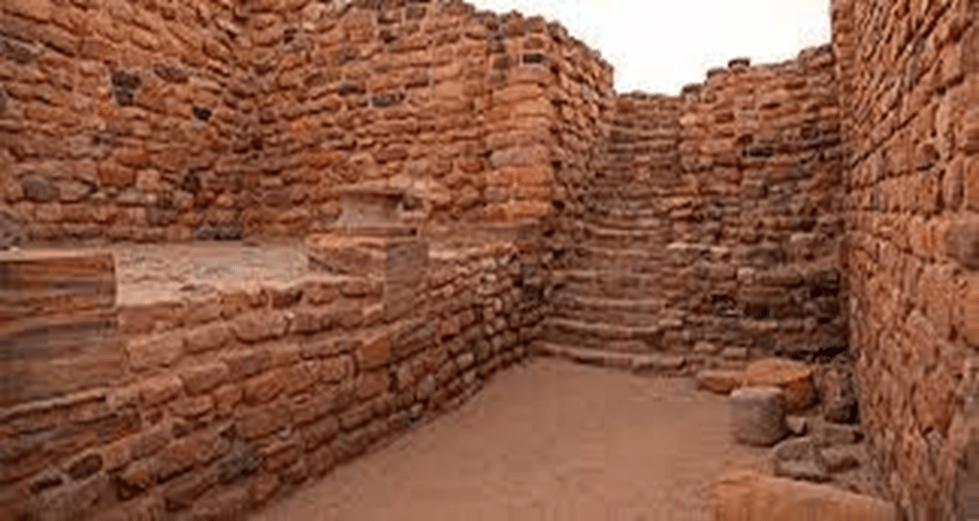
It is the ruins of an Indus valley civilization site and the largest archaeological sites. This site has received the Indus civilization tag This site is considered to be one of the cities of the Indus Valley Civilization. It is one of the major archaeological sites in India and has passed into the World Heritage label as the first civilization site in India. Diggings show prearranged thoroughfares and complex river management scheme.
It is believed that this city had trade links with places as far as Mesopotamia and Oman.
The most exclusive features of Dholavira are that it boasted of a very urbane water conservation arrangement full of networks and tanks. These must have been the earliest and the most unique, built of stones. These reservoirs were used as fresh water storage from rains or water stored which were diverted from the rivers. These storage springs from the fact that Kutch was having a desert type of climate with scarcity of rains. Sixteen or more reservoirs were found of different sizes. These reservoirs were cut vertically through stones. Most of them were 23 feet in depth and nearly 259 feet long. The stronghold and the bath were located in a central place while the reservoirs bordered through the cities. We also see a large well, actually a trough cut in stone, which connects to a drain for leading water to a storage tank. The tank which was used for bathing had steps plunging inwardly. It is said that earthquakes occurred repeatedly in Dholivara. A very severe one in 2600 BC must have led to its decline.
2] Poompuhar in Tamil Nadu -It was in the south in Tamil Nadu. In ancient times it was known as Kaveri Poompattinam, the port city.
It was the capital of the Chola Kings in their early times. Its location is near the mouth of the Kaveri River on the sea coast. We can find description of this city in detail in the fifth book named Shilapathikaran. This city was built on the banks of Kaveri River in the north and had two districts named Maruvurpakkam and Pattinappakkam. These two districts were said to be distanced by stretches of gardens and orchards. As said, we can visualize the daily markets called Nallangadi during the day and Allangadi during the night time held under the shades of big big trees.
This city was destroyed in 300 A.D by sediment erosion and tsunamis time and again. We see mention of such Tsunami in the Tamil poem ‘Manimekhalai’ which says that the city was submerged by the sea.

The Town of Muziris in Kerala
The port city of Muziris was a unique one in the world. The city was also called Murachipattanam. If we read The Ramayana, we will come to know that it is a place where Sugriva’s people scampered around searching for Mata Sita after her abduction by Ravana.
Kerala was established as one of the most important centers of spice and the port of Muziris was the pivot of trading activity related to spices .If we read the archives of the first century we can find that Muziris was only at a distance of 14 days’ time from the Coast of Egypt’s Red Sea ports. The description in the Sangam literatures speaks of ships from Rome full of gold coming to Muziris to exchange with pepper.
But sadly, it was a tragedy when in 1341, the contours of the Periyar river basin’s water bodies underwent drastic changes and Muziris vanished due to floods and earthquakes. The Muziris heritage project is trying its level best to preserve the leftovers of the seaport and its former magnificence which will forever remain as a reminder of its glorious past. It is very difficult to trace back the history of Muziris.
Muziris was endangered by attacks from the bandits of Nitrias. This attack must be in retaliation to the subjugation of Muziris by the Kings of the Chera dynasty.
We need to study the Muziris project to understand the study of the Jewish settlement. The Jews migrated to Kerala due to marketable acquaintances with Isreal. It is also said that about 10,000 Jews came to the coastal belt of Kerala in 68 AD. This was to actually avoid the holy maltreatment at their homes. This Jewish community settled in Muziris and became a strong force in the economic and political lifetime of Kerala. They were considered as prosperous business men who had the support of the then rulers. They enjoyed a tall upright position in the society. When the Portuguese arrived in in Kerala, they victimized them and they were forced to leave for Kochi in 1565 but it was temporary. The Cheras relied on the Jews for their financial expansion and for marketable affluence of Muziris.
The Jewish synagogue which was built at Chendamangalam, had a momentous, artistic and artistic importance and was a tourist destination. There was a Jewish graveyard which was positioned little far off from the synagogue on a hillock named Kottayil Kovilakam, along with a Krishna temple, a Muslim Mosque and a Christian church. This shows and provides sufficient evidence of the religious harmony of those periods.

Lothal In Gujrat
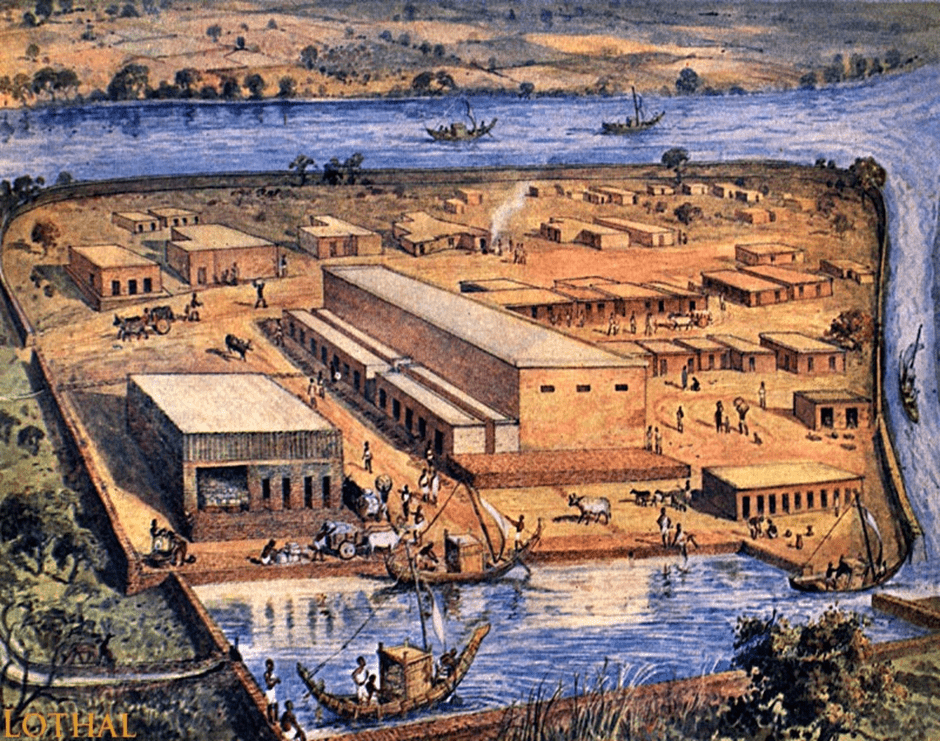
Lothal was considered the southernmost sites of the ancient valley civilisation.It had the earliest dock in the history of mankind. This dock connected Lothal through an ancient course of the Sabarmati River through various trade routes between the Harrapan cities in Sindh, Saurashtra peninsula where the Kutch desert was actually a part of the Arabian sea.
Today the remains are in the Bhal area of modern Gujrat, connected by all -weather roads to the cities such as Ahmedabad, Bhavnagar, Rajkot and Dholka.
During the excavations, troughs sunk in the northern, eastern and western edges of the embankment were found. This may have been the creek channels and ravines which connected the dock to the river. Also, a township and a marketplace were found along with the dock and the embankment.
Lothal seems to have thrived for many years though it faced constant threats of tropical storms and floods. Ultimately these must have caused largescale destructions leading to its end. If we look at the tropical analysis, we can see that at the time of its destruction or end, the area suffered from aridity and weakened monsoons which must have led to its abandonment. Thus, climatic as well as natural disasters may have been the end of Lothal.
Kalibangan in Rajasthan
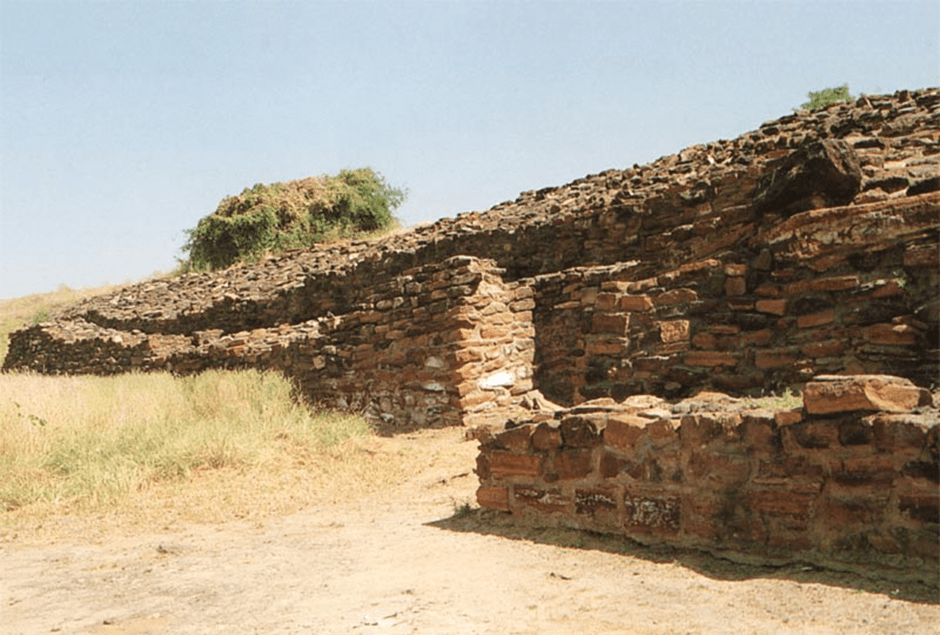
This town was located on the left or southern banks of Ghaggar Hakra river in Hanumangarh district of Rajasthan. It was established in a triangle of land at the confluence of the Sarasvati and Drishadvati rivers. It is said that LUIGI TESSITORI, an Italian Indologist, who was doing some research on Indian texts, recognized the pre-historic, pre- mauryan character of the Indus Valley civilization at this site.
This settlement was found to be fortified by using dried bricks made of mud. It is also found that the fort here was built twice during different time periods and the second time the thickness of the fort walls was increased from 1.9 meters to 3.7 to 4.1 meters. The brick size which was used for the same was 20x20x10 cms. The town planning resembled Mohenjodaro or Harappa Also there were ovens and cylindrical pits built of burnt brick and lined with lime plaster.
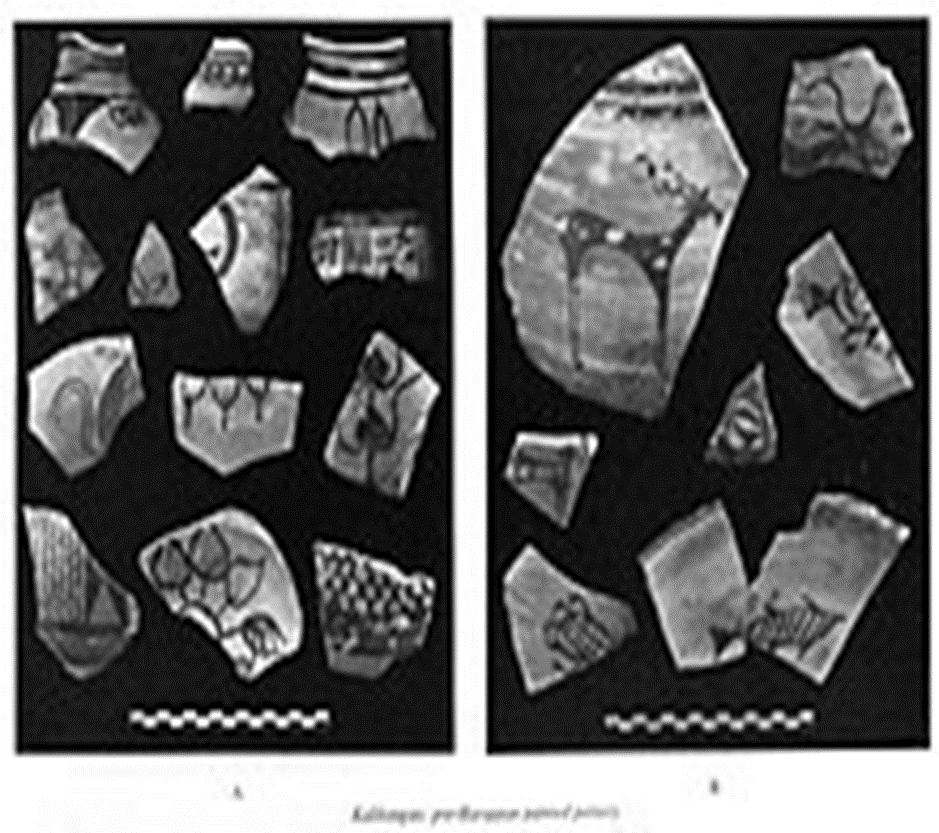
The pottery which is found in Kalibangan is divided into six fabric groups. A,B and D are redware, whereas Fabric C pottery was violet and black and termed as subtype of black and red ware. This peculiar characterization of early Harappan period were later found in Sothi – Siswal culture which is considered to be a sub- type of the early Harappan period.
It is found that the site saw an earthquake in around 2600 BC. This was the end of the earliest Indus settlement at this site.
Surkotada in Gujrat
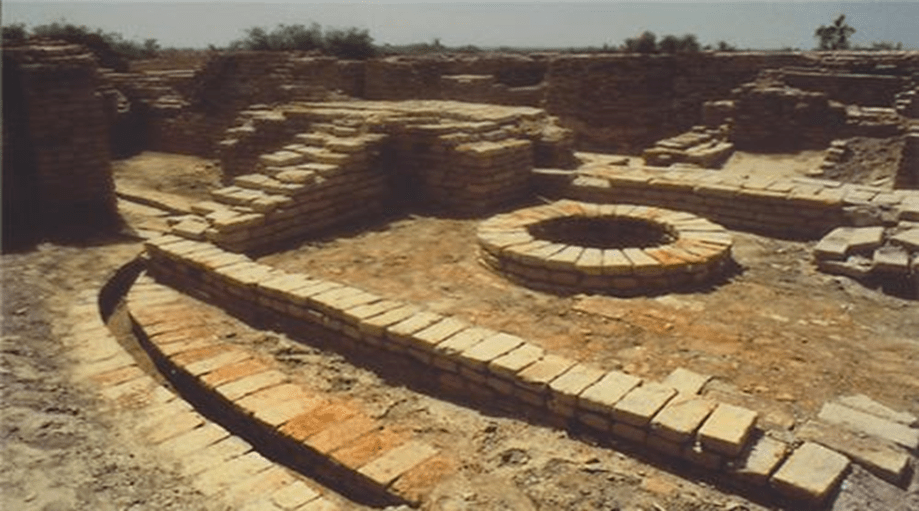
In the north -east region of Bhuj in the Kutch district of Gujrat is the site of Surkotada. This antique embarkment is surrounded by a surging rising ground huddled by small sandstone hills. These hills are enclosed with red laterite earth which gives the whole region, a reddish-brown colour. In this area the vegetation is very less mostly of cactus, babul, pilu and thorny shrubs.
The early inhabitants had associations with an inherited culture. The housing areas comprised of houses which were minor than the bastion households. An archetypal sample of this is a household with five interrelated accommodations, a patio shut on three sides and a podium outside fronting the road. The podium would have been used for dealings and as a workshop. The southerly rampart wall of the suburban part also had an entering which had established a diverse action by its manufacturers. It varies from further Harappan entrances in the sense that it is a traditional entrance and not a staggered or bent one.
All these landscapes show developed Harappan characters even up to 1700 BC which chronologically is fairly extraordinary. Established Harappan values were being followed in Surkotada long after the civilization had started deteriorating and other locations had decomposed or perished.
Surkotada shows the impression of the medieval organization of management in the development. We can say that Surkotada could have operated as a provincial capital or military base city.
Dwarka in Gujrat
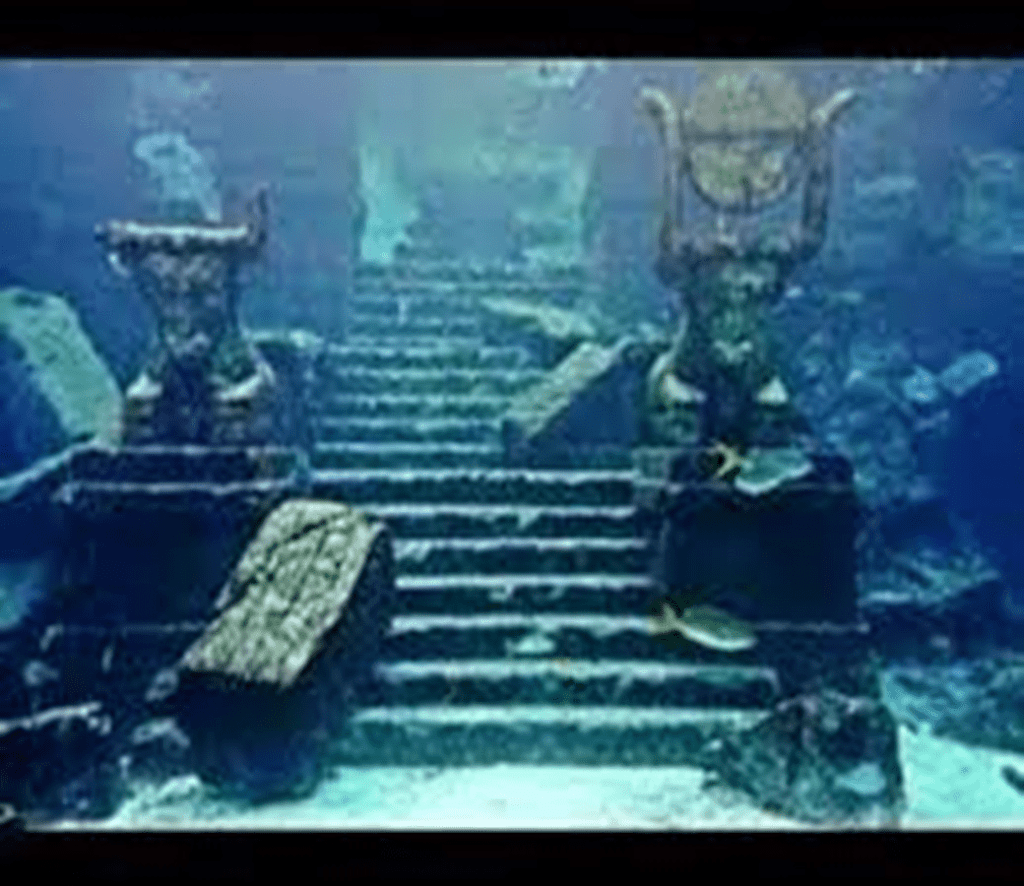
This city which is ancient as well as sacred to the Hindus is said to have been sunk in the Arabian sea. Archaeologists have proved its existence and work is still in progress. This city is not only of religious importance but also important for the archaeologists as it has reference in the mythological epic, The Mahabharata as the kingdom of Lord Krishna. It was a fortified city and spread over nearly 84 kilometres and was placed where the river Gomti met the Arabian sea. This ancient city is said to have sunk beneath the sea on the death of Lord Krishna.
In the last century, many artefacts were discovered under the sea like stone blocks, pillars etc. It will be a great achievement if the whole city is earthed and prove to be very fruitful to understand Indian mythology.
Pattadakal in Karnataka
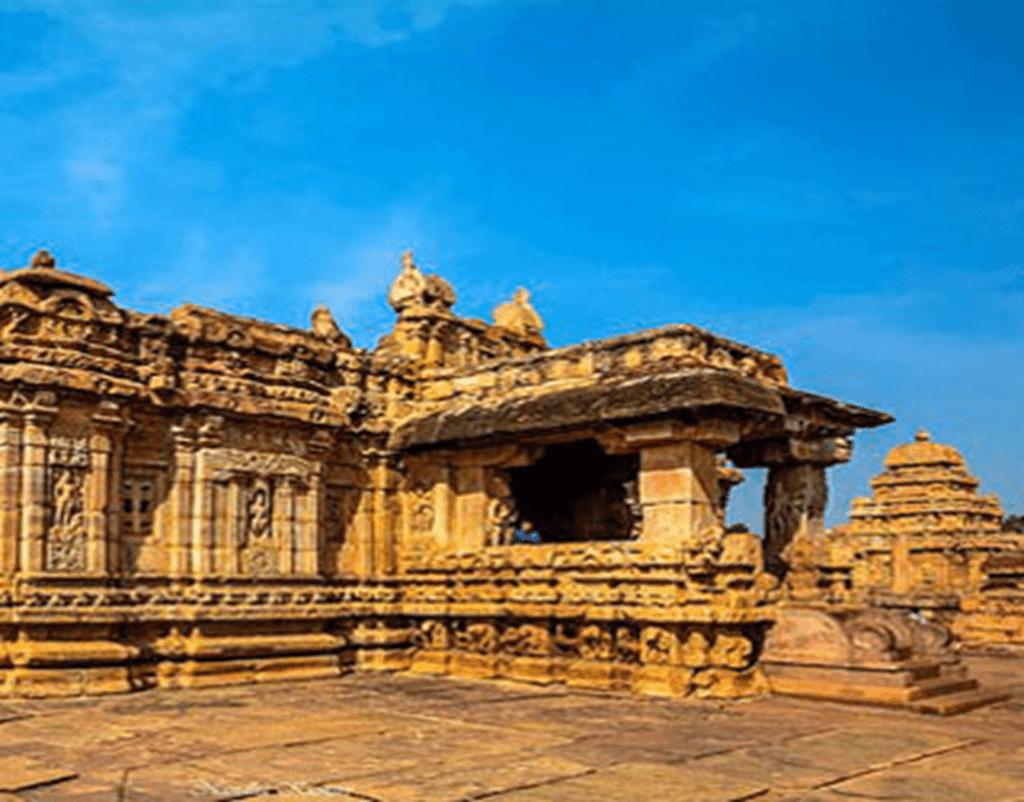
It is located in the northern part of Karnataka in the south. It was the main centre of art and culture of the Chalukya dynasty. We can see the endless engineering marvels of the expertise of the artists even after 1500 years. Today also we are enthralled with the magnificence and loveliness of the enormous colossal shrines and the intricately planned monuments, columns, galleries and the porticos.
Pattadakal houses nearly ten beautifully designed temples which has intricate designs and structures and is known as the “CITY OF CROWN RUBIES”. It was the city where the coronation ceremony of the Chalukyan Kings took place. When we see through the ten temples we will find that the nine of them are Hindu temples and one of them is a Jain sanctuary, maybe because Jainism was at its peak in the 9th century when the Chalukyan dynasty met its end.
Now we have to analyse why most of the ancient cities and civilizations came to an end.
The reasons can be the following like the deserts intruded on the fertile lands, or floods and Tsunamis destroyed the cities and civilizations. Also, the Aryan invaders killed the inhabitants of the Indus valley civilizations i.e., the Harappans who were said to be peace loving and did not have any weapons for their defence. Also, another reason was the changing river patterns like the drying of the Hakra river and the changes in the course of the Indus River which disrupted the agricultural and economic systems to such a large extent that people were forced to desert the places and move to other fertile lands. But most important reason were the earthquakes and the epidemics.
Thus, we can see that by the 1700 B.C the Indus valley civilization broke up into small clusters called Harappan or post – Harappan cultures.
Conclusion:
We can say that the Indus Valley civilization gave us the early concepts of Hinduism but the present civilization is an amalgamation of several cultures but even then, the contribution of the Indus valley civilization is the greatest.
Today the global eco systems are on the verge of colossal damage and collapse and the day is not far when this civilization will also come to an end due to the large-scale biodiversity and eco-system damages as a result of selfishness of mankind.
The alarm bells are ringing and we need to act fast if we have to give something to our future generations. This can only be done if we conserve nature, restore nature and make use of nature in a sustainable manner. We are seeing large scale disappearance of different species due to fast paced urbanization and eradication of the forest ecosystem.
The other day I went to Yeoor hills for a party and I was shocked to see the large-scale elimination of the green cover due to selfish interests of human kind in the forest areas. Each person needs to do his bit. Only relying on the government agencies and international lawmakers is not enough.
Request to one and all –
- We need to recognize areas of land, water bodies and oceans and stop industrialization in those places.
- We have to protect NATURE or NATURE WILL STOP PROTECTING US AND OUR END IS VERY NEAR. We need transformative changes and in a very short time.
- We need to find sustainable methods to satisfy our wants, not at the cost of the natural habitat.
- All freshwater bodies need to be protected and many more to be built.
- We have to break the present outline of consumption and surplus waste.
In the end I can only say that instead of living in fear eternally, it will be better if we aim to visualize a safer and better world through our necessary and fast actions.
 Art Of Teaching
Leave a comment