
MA ASHCHE
[ MOTHER IS COMING]
Some Important Rituals Followed During Durga Puja and Its Importance
Mahalaya:
Mahalaya marks the end of Pitri Paksha and the arrival of Matri or Devi Paksha. For Hindus Pitri Paksha is considered to be inauspicious as Shraddha rites are performed during this period. Here people pay homage to their ancestors through Puja and Offerings. We celebrate the occasion of Mahalaya nearly a week before Durga Puja. Bengali Households wake up at the onset of Dawn, to listen to a collection of Mantras and songs invoking the Devi Durga and to awaken her. Many people also do Pitri tarpon on this auspicious day to offer prayers to the departed in the form of Pind- Daan on the banks of the Ganges River.
What is Khuti Puja ———
It is a usual sacramental ceremony carried out by the different puja Mandals and Clubs to start the festivities of Durga Utsav. It is derived from the age-old tradition of ‘Katham Puja’ that is the wooden mount on which the earthern idol of the Devi is built. Khuti Puja is a norm followed by all Sarbojonin Puja clubs and Mandals to get together all members to unofficially start the Puja with a Get- to- Gather type of occasion and bless the successful completion of the Puja. We should not forget the sacrifice and soundless contribution of the Khuti as the Mandap starts taking the massive shape to house the Goddess in full splendour. This Khuti should serve as an inspiration for all devotees through its teachings of positivity, shunning of negativity, invigoration, and hard work to welcome Goddess Durga.
Kumari Puja——-
The basis of the origin of Kumari Puja was Dakhineshwar in Kolkata. Shri Ramkrishna envisaged Ma Kali in his companion, Sri Sarada Ma. Slowly, this ritual spread in other parts also. Ma Durga is worshipped in numerous forms during her stay here. The most important is “Kumari”, the Virgin form. This shape of worship is considered as the most powerful form of Adi Shakti.
A very young girl, who has not yet reached puberty, symbolising the Kumari form of Devi Durga is revered in front of the Goddess. It is said that Kumari Shakti is the origin of all creation. Kumari Puja is done to make human kind feel nearer and closer to them as Kumari in human form, thereby lessening the larger-than-life stature of the Divine Goddess. There is a need to select the Kumari very prudently, as she will be the conceivable representative of the Goddess and should possess the qualities of purity, vigour, calmness, serenity and bereft of longing, worldly desires and specifically anger.
NaboPatrika and Kola Bou ——
The above is a very important ritual which is celebrated with great zeal and pomp in West Bengal. Arrival of Ma Durga also symbolises the arrival of Harvest and symbolises the harvest season of healthiness, affluence and wealth. It is not only a religious festival but also a representation of reunification, transformation and a festivity of traditional ethos and rituals.
This ritual is done by gathering nine different plants and bundling them together with a holy thread and placing them on a stand for worship. Thereafter they are given a bath in holy water, usually the Ganges in Kolkata and offered flowers, fruits, sweet delicacies and dhoop and agarbattis.
At dawn on Saptami day, which is the seventh day of Navratri, Goddess Durga is summoned or invoked in NabaPatrika which is tied to the branches of Aparajita plant with a yellow-coloured thread. The nine plants are the nine forms of Adi Shakti. Banana Plant or Plantain represents Goddess Brahmani, Colocasia plant or Kochu is representative of Goddess Kalika, Turmeric or Holud plant of Goddess Durga, Jayanti plant symbolises Goddess Kartiki, Bel Leaves – God Shiva, Pomegranate – Goddess Raktadantika, Ashoka – Goddess Shokarahita, Arum or Man Kochu plant- Goddess Chamundi and Rice Paddy or Dhan- Goddess Lakshmi. Lord Shiva is included in NabaPatrika and also some variations are seen as per the regions. After giving a bath and offerings, mantras are chanted and the NabaPatrika is adorned in white saree with red border.
Kala Bou ——-
Actually, the ritual of Kola Bou is actually the sanctification of all the nine plants on Maha Shasthi, and then on Maha Saptami they are sanctified as above. Thereafter Kola Bou which should ideally represent all nine plants are nowadays restricted to only the prominent banana plantain which is dressed like a bride and placed on the right side of Lord Ganesha. We can say that Lord Ganesha is said to be the creator of eighteen medicinal plants and therefore known as Astadasausadhisrsti. That is why maybe NabaPatrika or Kola Bou is considered as Lord Ganesha’s wife as it represents the auspicious plants.
On Dashami day, Kola Bou or Naba Patrika is dismantled and it is immersed while chanting mantras. This is done in isolation. The priest performs the ritual. The Durga idol is immersed in water only after the Kola Bou or NabaPatrika is immersed.
Anjali —-
The rituals during Durga Puja are performed by the priests, Thereafter Pushpanjali which is a floral offering to the Goddess is performed known as Anjali. Anjali ritual happens from Shasthi to Nabami. The most auspicious time for giving Anjali to the chanting of the Mantras is the morning time. It is traditional to keep fast until you give Anjali to the Goddess. Everybody takes a bath and wear new or clean clothes before approaching to give Anjali. The mantras are repeated after the priest and devotees throw the flowers at the feet of the Goddess. The rounds of Anjali for each person are three in number.
Dhunuchi Naach
Source – Google
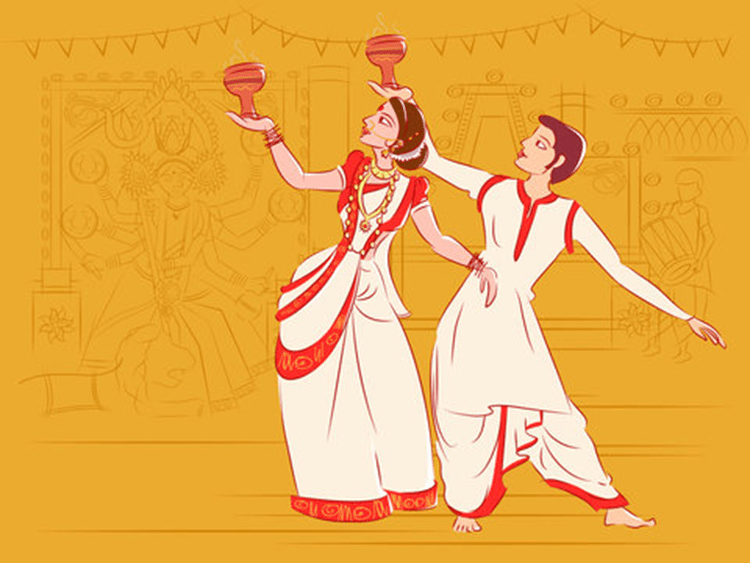
This religious dance is accomplished holding a dhunuchi, which comprises the red-hot coconut husk with dhuno speckled on it. Dhuno, the Indian comparable of frankincense, is a vegetable gum of sal tree, and dhunuchi is basically an incense burner that holds the fire. Dhunuchi is a wide shaped clay container held by a stem. Dhunuchis are conventionally made of clay that has natural insulation assets. It is ignited by setting fire to the dry coconut husk on which dhuno and camphor are scattered. Many may also place a coating of burning coal at the bottom that burns the coconut husk, on which dhuno and camphor are scattered for the perfumed smoke. Dhunuchi Dance or Dhunuchi Aarti is executed to thank the Goddess. The Bengalis consider Dhuno as a purifier, that is why it is offered to the Goddess. The Dhunuchi Aarti or dance is performed to the beat of the Dhak. We need to balance the Dhunuchi with hands or on the forehead or mouth. This is performed by both genders in Durga Puja.
The Ulu Sound and The Sound of the Conch Shell: –
Source – Google
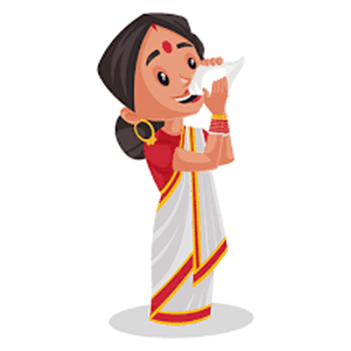
The Ulu sound is a vocal sound made by a group of Bengali women during auspicious occasions. The ritual is said to have its origins in the medieval times. This sound is sacred and brings about positive energy. It is also believed that it has the power to drive away the evil spirits.
It is said that the conch or the Shonkho was initiated during the Samudra Manthan and we see it in the hands of Lord Vishnu and therefore considered to be auspicious. It is a part of our Hindu tradition and it is said to do away with all negative energy in the surroundings. It is said to calm our mind and make our surroundings spiritual and holy. During Durga Puja, conch is puffed to appeal for the blessing of Gods and Goddesses for positive conclusion of the Puja. Conch sound is auspicious because it is a shell that is found in the ocean and therefore it is a natural sound instrument.
Sindoor Khela:
Source- Google
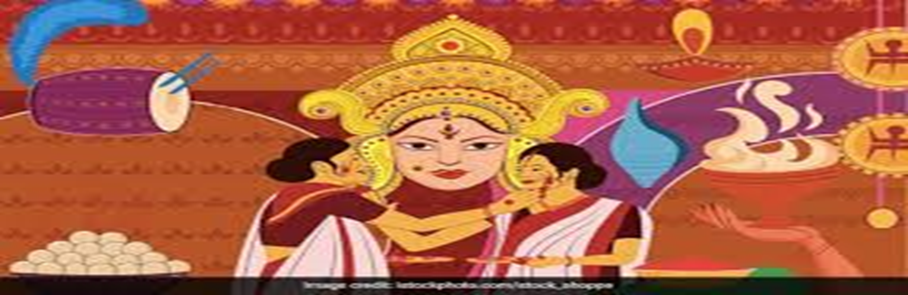
The literal meaning of these words is playing with vermillion powder. In this traditional event, married ladies used to decorate the forehead and feet of Goddess Durga and other deities with vermillion or sindoor on Dashami Day while saying goodbye to the Goddess and her children. It was followed by them applying sindoor on each other’s forehead, on shankha, pola and noa- which are considered the three customary bangles which all married Bengali women wear. These are made of conch shells, coral and iron respectively. This tradition is followed even today and thereafter they eat sweets and dance to the beats of the Dhaki drummers. Women traditionally wear white sarees with red border and do ‘Debi Boron’ followed by Aarti. After this the Goddess is applied sindoor and offered sweets. The visarjan of the “Ghat” denotes the end of Durga Puja and the festivities.
Bishorjon—–
On the Dashami day the Goddess Durga and her children Ganesh, Kartik, Lakshmi and Saraswati who had come to Devi Durga’s maternal house are taken out in a procession to the beat of drums by the Dhakis and the dance on the beats of the Dhak by the worshippers. The Goddess and the other deities are immersed in the river or sea or any water body which marks their return to Mount Kailash, the abode of Lord Shiva, their father.
This marks the end of Durga Puja celebrations. After the immersion, Shanti Jal is sprinkled on the devotees by the priest with a mango twig from a copper pot which carries water of the water body where the Goddess is immersed.
Bijoya—–
After the Festivities and immersion, young people take blessings from the elders by touching their feet. Elders bless the young ones with long and happy life and distribute sweets. Males who are of the same age perform the act of Kolakuli, which is a kind of hugging each other ritual. Special sweets like Naru (made of coconut and Jaggery) are distributed. Women are supposed to prepare different kind of savouries and sweets at home. Also, some Bengalis bring ‘Joda Elish’ during Dashami into their houses.
 Art Of Teaching
Leave a comment