What is Sandhi Puja ……
Sandhikshan is the stage of Ashtami and Navami Tithi when Sandhi puja is done. Sandhikshan is the last 24 minutes of Ashtami Tithi and the first 24 minutes of Navami tithi. This is an auspicious mahurat when Ma Durga killed Chanda Munda in the form of Ma Chamunda and gained victory. It is the most fruitful of all times to worship Maa Durga. If done appropriately it has the power to sanction the wishes and desires of the devotee. This puja was performed by Shri Ram in Treta Yug when he was able to please the Goddess who granted him weapons to gain victory over Ravana and blessed him for the same.
Ma Chamunda –
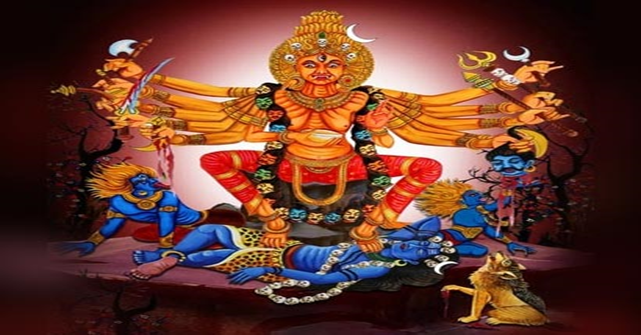
Source – Google
Ma Chamunda is also called Chamundeshwari, Chamundi or Charchika. She is considered a fierce form of Adi Parashakti, Ma Chandi and is one of the seven Matrikas, namely Brahmani- wife of Brahma, Maheshvari- wife of Shiva, Kaumari- wife of Kumara, Vaishnavi- wife of Vishnu, Varah- wife of Varaha who is an incarnation of Vishnu, Indrani- wife of Indra and Chamunda or Yami – wife of Yama.
We have a group of 64 to 81 Goddess who are Tantric considered as followers of Goddess Parvati, who is the Chief Yogini. Ma Chamunda’s residing place is the cremation grounds having a big holy Fig tree.
When Ma Durga and Mahishasur were engaged in a deadly battle, the two war generals of Mahishasur, Chanda and Munda had the audacity to attack Ma Durga from behind. At that time Ma Durga had the form of a beautiful Goddess with a radiance, hair tied on her head with a crescent moon above her forehead and a garland around her neck. Her ten hands had ten different weapons. But soon this beautiful Goddess turned blue with anger and turned to face Chanda and Munda. A Devi with a large broad slightly curved like weapon called the falchion and a shield, along with a sula along with a Kapala and munda emerged from Ma Durgaa’s third eye. Her face was big, she had a bloody tongue and eyes that were bloodshot and sunken. It was Chamunda who with a blood curling scream leapt forward and killed both of them. The moment they were killed was the intersection of the 8th and the 9th Lunar days. This is when Sandhi Puja is performed.
Iconography of Chamunda
The goddess was instrumental to kill the demons Chanda and Munda hence she named as Chamunda. The deity is known for her ferocious nature and mentioned as a consort of Bhairava who also bears ferocious character. The deity is also considered as a goddess of death and time (Kinsley 1975). There are multiple aspects which are discussed in the texts due to this the fearful nature of the deity developed as its identical element. This ferocious element seen represented through the skeletal body, with a terrifying face, sunken eyes, gaping mouth, pendulous breasts, long nails and a sunken belly surrounded by flesh and bloodthirsty wild animals. The mount of the deity is a preta (corpse). Some opinions vary which claims that it is not a preta rather it is himself Shiva who laid beneath her in order to get her to calm down from anger after killing a demon (Soundarajan 2003: 267‐71).
How was the time of Sandhi Puja measured in olden days:
In olden days the devotees devised a number of ways. During the last 24 minutes of Ashtami, a bowl of bronze metal which had a small hole was kept in a bucket full of water. The hole in the metal bowl was made in such a way that it took exactly 24 minutes for the metal bowl to sink in the bucket full of water. When the bowl sunk in totality, that was the exact moment to announce the start of Sandhi Puja and it was done by firing the cannon balls.This type of yardstick to measure the appropriate time of Sandhi Puja were used by the Zamindars of Shobhabazar and Sutanuti Rajbaris.
The King of Krishnanagar, Raja Krishna Chandra had received the cannon of Plassey from Robert Clive as a gift. This cannon was used by him to announce the Sandhi Puja timings. In the place called Shikarbhum Rajbari, a plate full of Sindoor [vermillion] was kept in front of Ma Durga and when Ma Durga’s footprints were seen on the plate that was the exact moment for start of Sandhi Puja. The Zamindar of Barisha, Sabarno Raychoudhuryworshipped Ma Chamunda by burning the two types of fishes namely: Layta and Phouli.
Where do we find temples of Ma Chamunda:
1]Chamunda Devi temple in Palampur in Himachal Pradesh in Kangra district.
2]We can find two Chamunda Devi shrines on the hills of Chotila and Parnera in Gujrat.
3] We can find innumerable Devi Chamunda temples in Odisha state of India. The temple known as Baitala Deula was considered the most important one in the city of Bhubaneshwar. Also, Mohini and Chitrakarini temples in Bhubaneshwar along with Kichakeshwari temple near Baripada and Charchika temple near Banki represent ma Chamunda.
4] We can find the famous Chamundeshwari Temple on the top of the Chamunda hills in Mysore in Karnataka.
5] We can see the Chamunda Ma temple in Mehrangarh fort in Jodhpur. She is the kuldevi of the Parihar rulers.
6] The Chamundeshwari Kshetram temple is located near Jogipet in Medak district of Telangana.
7] We find the Sree Shakthan Kulangara temple which is a temple of Ma Chamunda in Koyilandy, Kozhikode District in Kerala.
8] At the top of the Tekri hills in Dewas, Madhya Pradesh, we can find a Chamunda Temple. Here she is addressed as Choti Ma, the younger sister of Tulja Mata whose temple is also situated at the same hill top.
We can find references of Ma Chamunda in Buddhism and Jainism also.
We find that Chamunda is related to Palden Lhamo in Vajrayana Buddhism. Here she is revered as a ferocious form of Ma Kali and consort of Mahakal. Ma Chamunda is said to be the protector of Dalai Lama and Panchen lama who belong to the Gelug School.
In Jainism the most famous legend of Ma Chamunda is that of Ratnaprabhasuri. Here it is mentioned that Ma Chamunda carved the image of Mahavir for the Osian Mahavir Jain temple at Jodhpur in Rajasthan.As the Jains were unable to offer animal sacrifices, the Jain monk Ratnaprabhasuri intervened as a result Ma Chamunda accepted vegetarian offerings. She was named Sacciya by the monk and became the protector of temple and also was the clan goddess of the Osval community. The important Sachiya temple was built in the honour of Ma Chamunda by the Jains. We see the many in the Jain community worshipping her as their Kuldevi and Samyaktvi demi Goddess as per the rituals of the Jain community.
Importance of Sandhi Puja in Bengali customs:
The people performing the puja fast till the Sandhi Puja is over. 108 diyas are lit which symbolises arrival of light over the darkness. The puja is performed to the accompaniment of dhak, sonkho, ghanta and ulu dhoni and is said to ward of negativity of the devotees and any type of evil eye. 108 lotus flowers are offered which represents beauty and life. Also 108 garlands of bel leaf along with saree and jewellery and fruits are also offered. The sonkho is blown to eliminate any type of bad energy and Shantir Jal [ Holy water] is sprinkled over the head of the devotees. Aarti is performed along with Havan which marks the culmination of the whole puja. Ma Durga has 108 names and that is why the numerical 108 has a lot of significance in Sandhi puja.
I end by stating the below addressed Ma Chamunda Dhyan Montro ——-
চামুণ্ডার ধ্যান —
ওঁ কালী করালবদনা বিনিষ্ক্রান্তাসিপাশিনী । বিচিত্র খট্টাঙ্গধরা নরমালাবিভূষণা ৷।
দ্বীপিচর্মপরিধানা শুষ্কমাংসাতিভৈরবা। অতিবিস্তারবদনা জিহ্বাললনভীষণা। নিমগ্না রক্তনয়না নাদাপুরিতদিন্মুখা॥”
 Art Of Teaching
Leave a comment