We say we are sympathetic when we see other’s disaster and feel bad for that other person.
We say that we feel Empathy when we comprehend and communicate the other person’s emotional state about their bad luck.
If you hear about a flood situation or a terrorist attack where many have lost their lives you feel sad and that is sympathy.
When you are beside someone close to you and holding the person’s hand in his suffering and can feel his pain, that is empathy.
These words are often misunderstood as there is a very fine line between them, yet they are different.
When you share the sentiments of the other individual, it is said that you feel empathy. But when you feel apprehension about the predicament and sorrow of another person it is sympathy.
When you feel empathy, you play a very active role in understanding the painful experiences of the other person and providing due help and consolation which should be positive and non- intrusive in nature.
We can simplify it through a simple example.
Situation – A child failed in SSC Exam
- I don’t know him so it does not affect me, nor do I care. So I am indifferent and I lack any kind of emotion – APATHY
- I feel sorry for the child and wish him better luck next time. But his failure does not affect me emotionally though I offer consolation – SYMPATHY
- I feel the emotional state of the child deeply. I have seen failure in my life and can relate to the sensitive instability the child is going through but I would not want to alleviate this by being vocal about this – EMPATHY
- I take steps to see that the suffering of the child can be removed by some positive action from my side – COMPASSION
I hope this example has made it easier to understand the basic difference between the words.
The word “apathy” wasn’t coined by one specific person but was borrowed into English in the late 16th century from Greek (apatheia), meaning “without feeling,” originating from a- (not) and pathos (emotion/suffering), gaining use in philosophy (Stoics for freedom from passion) and later describing modern disinterest.
The word “empathy” was introduced into English in 1909 by British psychologist Edward B. Titchener, who translated the German term “Einfühlung” (meaning “feeling into”). German philosopher Theodor Lipps originally coined Einfühlung in psychology around 1903 to describe projecting oneself into art or another person’s experience, a concept Titchener then adapted into English as “empathy”.
The word “sympathy” wasn’t coined by a single person but evolved from the Greek word sympatheia (feeling together), used by ancient thinkers like the physician Galen (2nd century) to describe shared physical sensations, while its modern English use for compassionate feeling emerged in the late 1500s, famously appearing in works by writers like John Lyly and explored by 18th-century philosophers David Hume and Adam Smith.
The word “compassion” wasn’t coined by a single person but evolved from Latin and Greek roots, entering English in the 14th century, stemming from the Latin compassio (to suffer with) and the Greek sumpatheia, meaning shared feeling or sympathy, popularized by religious and philosophical texts. While figures like Shakespeare used it early on, its core concept reflects ancient ideas of shared suffering and empathy found in texts from Aristotle to Buddhist traditions.
I end by saying that ……. As a Counsellor I can feel the agony the patient is going through but I can not wish sympathy for my patient either way.
The Counsellor’s duty is to make the patient robust emotionally to help them overcome their difficulties. Though as a Counsellor I will surely be empathetic but it will not be in my place to display it in front of the patient. My object should be only to help the patient get well whatever it may take. At the same time as a Counsellor, I need to be very much aware of the thin line that splits up this alleged method from discourteous insolence and unresponsive behaviour. It is my duty to make my patient comfortable at every stage of therapy.
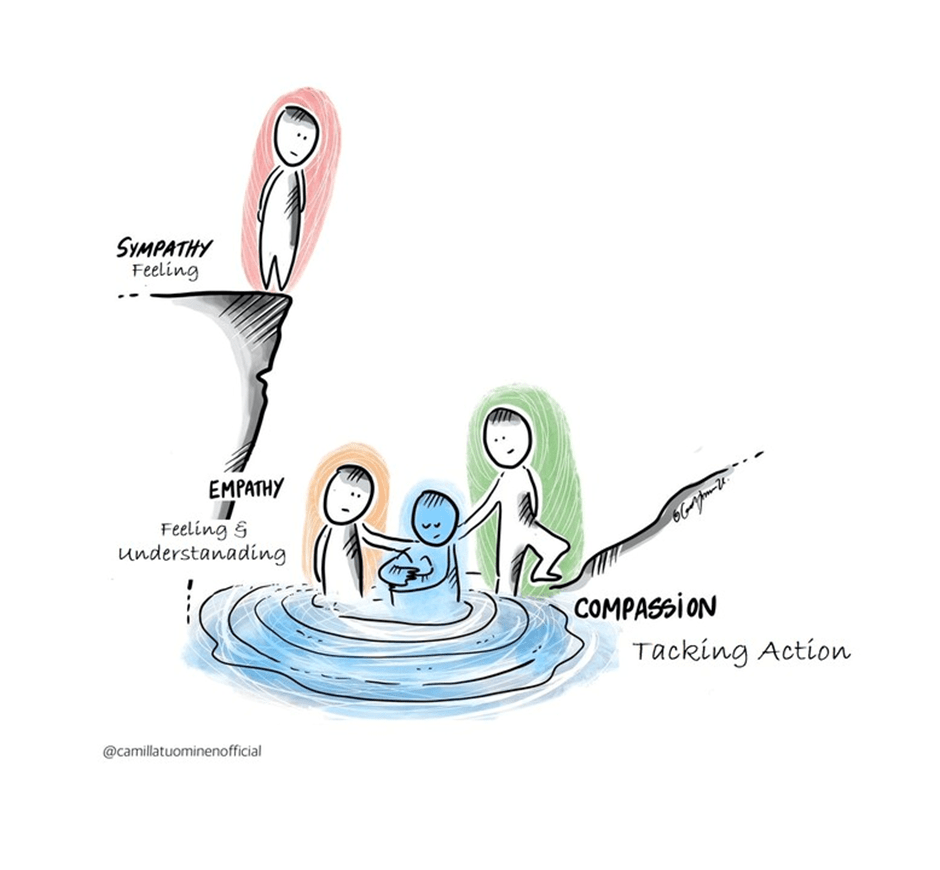
Source – Google
 Art Of Teaching
Leave a comment