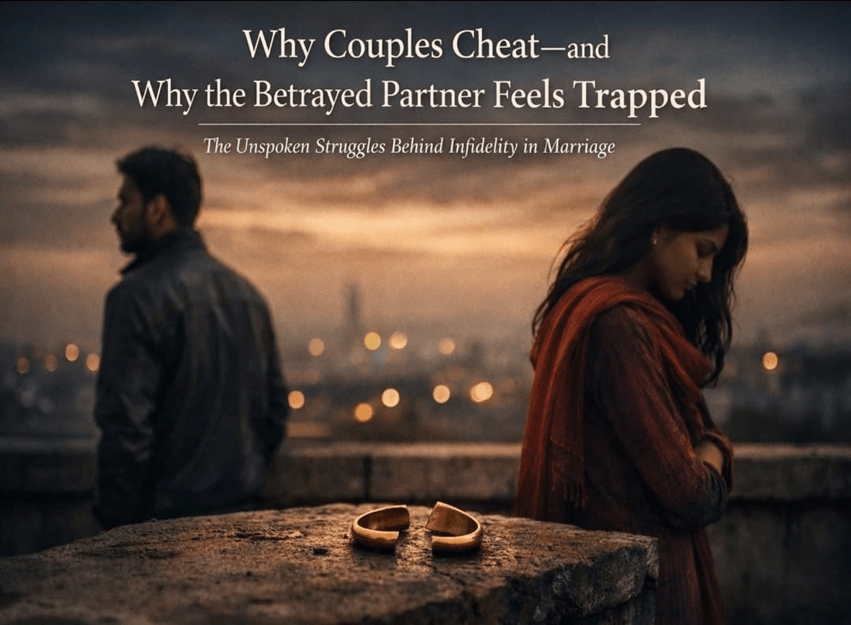
Hello Friends! This is my fifth blog as a counsellor. I am touching these topics as I am practically counselling on these issues at present.
Though matrimony is a revered pledge between two persons, and requires complete obligation, conviction and veneration between the husband and wife, the scenario is completely different in the present society.
Why couples cheat [especially in the Indian context].
Please remember that infidelity often grows from emotional distance rather than just physical desire. When communication breaks down, partners stop feeling seen or valued. Over the time resentment starts building quietly. In some marriages, particularly arranged ones, compatibility may never have been deeply explored, so emotional intimacy remains shallow, add to that sexual dissatisfaction, which is cultural taboo for discussion in our society. Therefore, the unmet needs and close proximity to others set off a series of wants and desires looking for an outlet.
There is also the question of validation. Some people cheat not because their partner is lacking but because they themselves are seeking attention, excitement, or ego- boosting reassurances from the other sex. Modern lifestyles, work place intimacy, travel, close proximity, social media has made opportunities more accessible. Also when one partner feels jealous of the other’s fame, looks and social contacts, they try to get back by seeking attention elsewhere.
We can pen down the reasons as multifaceted like emotional dissatisfaction, communication gap leading to distance and frustration, Sexual incompatibility and neglect eventually seeking fulfilment elsewhere, societal pressure and early marriages leading to feeling of wrong choice, opportunity and changing lifestyles, and lastly ego, validation or escapism.
It is important not to oversimplify this as a purely moral failure. Though infidelity is a breach of trust, it often signals underlying issues in the relationship or within the individual.
Why does the hurt partner often stay silent or “doesn’t take a stand”.
This is less about weakness and more about constraints and conditioning.
Many individuals, especially women in traditional setups, are financially dependent or worry about their children’s future.
Walking out of a marriage is not just an emotional decision- it can lead to social isolation, financial instability and family backlash. But not every individual is strong enough to face this.
Social stigma plays a major role. Divorce or separation is judged harshly in many Indian communities and people are often advised to “adjust” rather than “confront”. Those who do not confirm are termed as “Rebels”.
There is also emotional conditioning. People are taught to preserve relationships at any cost, to tolerate, to forgive repeatedly. Overtime, such persons may start doubting their own worth or normalizing the betrayal.
Fear is another factor- fear of conflict, fear of being alone or even fear that speaking up may make things worse. Also, it is sometimes the hope that the partner may change and the marriage can be saved stops a person betrayed from taking a stand.
But I feel there would be many who would be trapped between self- respect and survival. Many would choose survival and carry on with life navigating limited choices, responsibilities and deeply ingrained beliefs.
According to Esther Perel– “Understanding infidelity is not about justifying it – but about understanding what it reveals about relationships, human needs and the spaces we fail to nurture”.
What are your thoughts on this? Do you think silence in such situations is a choice or a compulsion specially for females in Indian society?
Please share in the comments.
 Art Of Teaching
Leave a comment