
When I selected Feminism as my topic for M.Phil. studies, I focused towards western feminism because my social acclimatizing made me look towards the Western literature for progressive thinking. But I found western feminism not to be universal in its scope. Though it was exclusive in itself, it was more tuned to the western values and could not be in a position to represent the Indian women. It was then I started looking into Tagore’s novels to search for a feminist viewpoint as I wanted to search for a voice closer to my home and culture. I wanted to view feminism through the lens of my feminine identities around me like my mother, grandmother and off course my immediate friends and myself too.
The first and foremost question in my mind was whether the writings of Rabindranath Tagore was competent enough to be termed as feminist writings. Yes, they were. Rabindranath Tagore penned about the factual womenfolk of colonist India not in fiction but in total rare magnificence. I found his feminine characters to be way ahead of time even in the present-day context. Tagore, through his female characters challenged the positioning of self-identity, domesticity, sexuality and off course the meaning of chastity.
Here I will take up only one woman from his novels, though there are many to be thoroughly discussed from the prism of feminism. BINODINI of Chokher Bali. In Tagore’s own words …….
‘An irate queen bee stings everyone that: comes in her path, and similarly, an irate Binodini was prepared to destroy everyone around her. Obstacles, and nothing but obstacles, that is what she had faced all her life. Was there no way that she could find some satisfaction, some amelioration? If she could find no happiness, then whoever stood in her way to frustrate her, whoever was instrumental in depriving her of all that she deserved, whoever conspired to deny her what were her rightful dues, would be mercilessly crushed and humbled. Vengeance would be hers.’
– RABINDRANATH TAGORE
Binodini was rejected by Mohin, Ashalata’s husband, and had to marry an older man which made her a widow at a very minor age immediately after her wedding. Situations led her to Mohin’s house, where she was a witness to the maturing love between Mohin and Ashalata, who were the newly wed couple. This kindled her jealousy and suppressed sexuality and she turned into the monstrous enchantress who tried to attract Mohin to herself because she contemplated that actually, the house, Mohin’s mother, Mohin, the bedroom would have been hers, had Mohin not rejected the proposal to marry her. Also, she developed feelings for Behari, Mohin’s friend but he was a friend to Ashalata only. She succeeded in her attempt to only find that Mohin was a selfish person who loved only himself. She tried to pursue her love for Bihari but was unsuccessful in her attempts and her advances were ridiculed and met with disdain and anger by him.
At the end of the novel, once Mohin and Binodini who had eloped , returned to perform the last rites of Mohin’s mother, she decided to go to Varanasi to live the virtuous life of a widow in isolation. She further rejected Bihari’s proposal to marry her, when he realised her love for him and softened his stance towards her. She refused saying that if he married her society would shun him for marrying a widow. Bihari let her go asking for a lock of her hair as a keepsake. Instead, Binodini gave him her legacy of two thousand rupees to serve the nation. She also showed him the scar on her arm which was a result of Bihari’s anger when he had pushed her violently. She told him that this was the best memento that she could have had from him.
In Tagore’s novels, every reading will render a new perspective in the mind of the reader as Tagore’s works are full of symbolism and you can read between the lines every time rendering a new meaning. It is correctly said that Tagore helped Indian Renaissance to reach its pinnacle and his writings will never be old in time.
Maybe in the true spirit of feminism, Tagore could have given a revolutionary ending to this novel by getting Binodini and Bihari married as a couple but maybe he took a step back due to the societal views of those times and as it is the book had faced a lot of criticism.
I personally feel here is the difference between Indian Feminism, compared to the Western Feminism. Indian Feminism is about family values and not treading upon breaking it, but also about women emancipation through literacy . Tagore has given importance to this fact, though not openly, by showing that his protagonist Binodini was a literate person, who could read and write, even compose poems. If Feminism means that lovers need to be united at the cost of family and society, then frankly, Bihari’s first love was Ashalata someone else’s wife. What we need to appreciate in Indian Feminist values is the fact that Ashalata’s dedicated and focused commitment towards her husband and Bihari’s selfless restraint helped to save a family and that is the ethos of Indian feminism. The message given by this novel is that though sacrifice does not provide satisfaction, gratification will also not provide the same.
Of course, Tagore himself says he regrets the ending of this novel and I could not agree any less. When a woman steps out of the set boundaries of patriarchy, she is blamed as a harlot and a man eater but not men like Mahindra who indulge in relationships outside marriage and break the set norms.
Women like Ashalata never retaliated and restricted herself as was the demand of the society in those times .She never once blamed Mohin for his actions as in that societal time, men were free to be promiscuous but a woman had to be pious and chaste. On the other hand, we have a character like Binodini who stood up to patriarchy in her own way. In recent society, we will find the likes of Binodini and Ashalata, and we need to admire both kinds, one for her mind and the other for her character. It is the circumstances which we face that decides what we become, Binodini or Ashalata.
I end by asking the readers to understand the below poem, internalize and act accordingly….
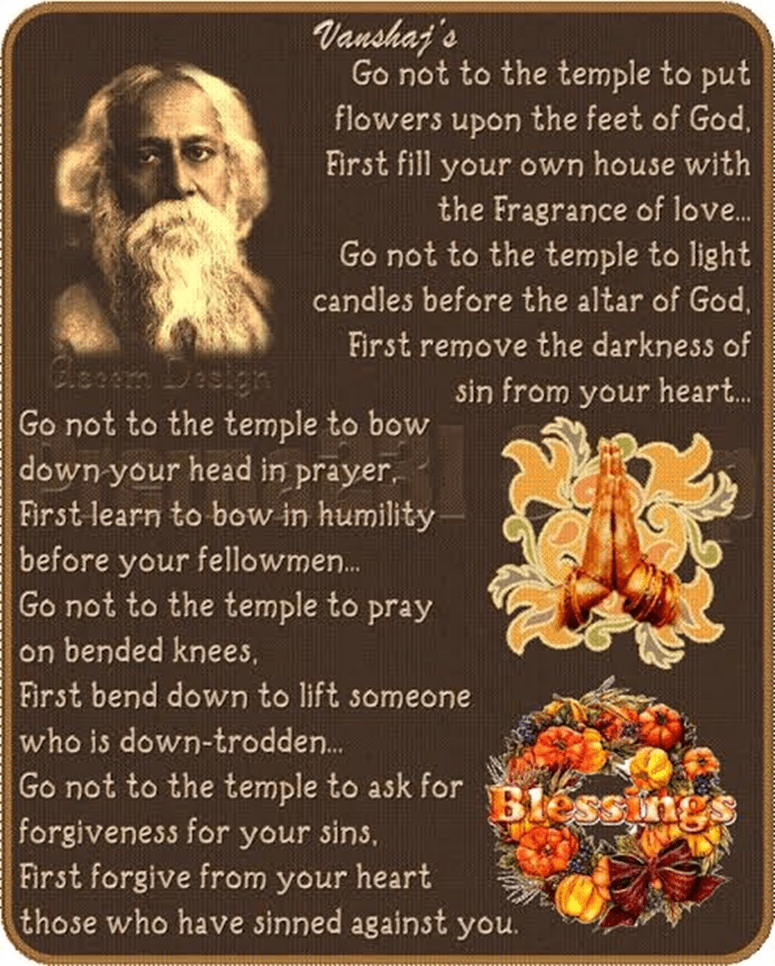
Source- Google

 Art Of Teaching
Leave a comment